
Why AI Projects Stall at the Demo, and What a Forward-Deployed Engineer Changes
Three numbers from reports published this year describe the same problem from three angles.
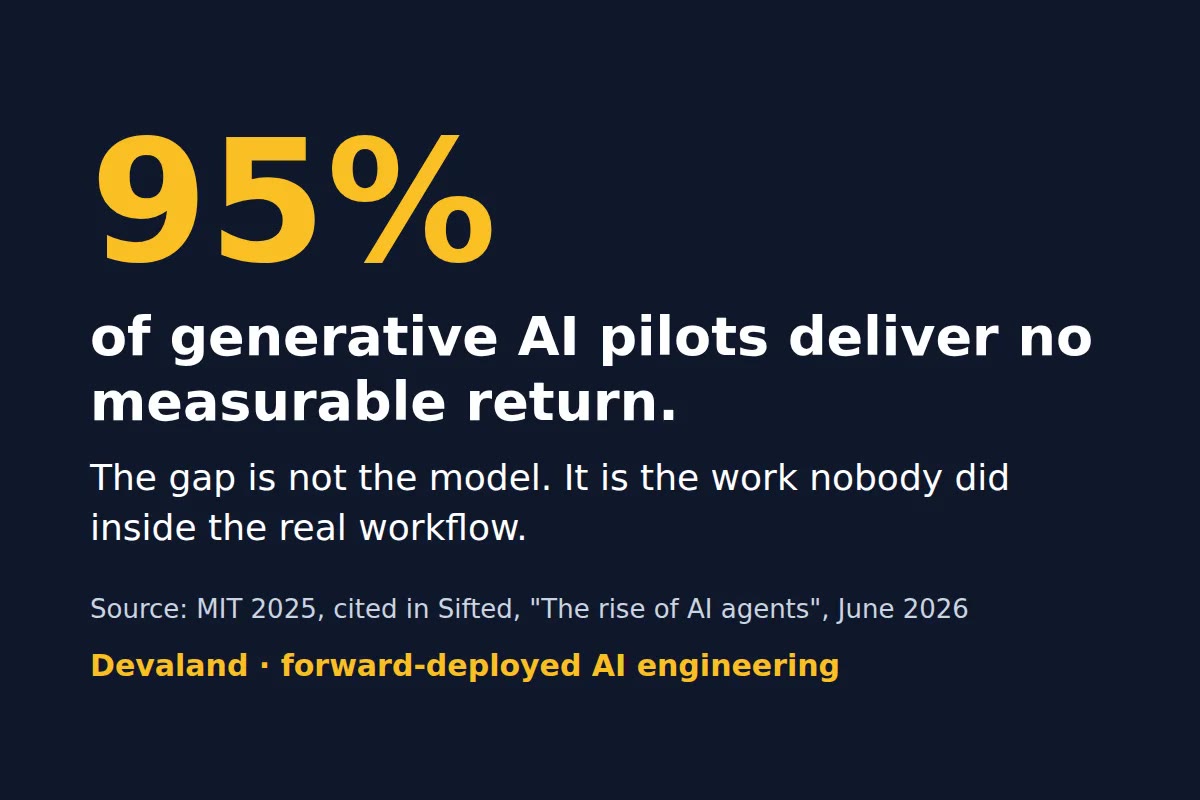
An MIT study from 2025, cited in Sifted's June 2026 report on AI agents, found that 95% of generative AI pilots deliver no measurable return. Dataiku found that fewer than half of AI agents make it beyond the proof-of-concept stage. And OECD data, published in September 2026 in a report by Sifted and London Business School, shows that only 5.2% of Romanian companies with ten or more employees used AI at all in 2025, the lowest of 35 countries measured.
None of these numbers is about the technology. A good model is available to anyone, cheaply. What they describe is the distance between trying AI and running part of a business on it.
The gap has a job title
The same reports keep returning to one role: the forward-deployed engineer. It is the model Palantir made famous. Instead of selling software and leaving the customer to work out what to do with it, the vendor puts an engineer inside the customer's actual workflow, to learn how the work is really done and to build the system around that.
It is not a niche idea any more. Sifted and redalpine's "European dynamism" report cites Fast Company data showing that job postings for forward-deployed engineers rose 800% between January and September 2025.
Why the demo is the easy part
A demo runs on clean, chosen examples. Daily work does not. The failures that kill AI projects are almost never "the model was not clever enough". They are:
The data does not match. One founder quoted in Sifted's agentic AI playbook said the hard part had "almost nothing to do with the AI itself", it was that the email metadata and the CRM disagreed about the same relationships.
Nobody defined correct. An agent told to "reply to customer emails" will produce something. Whether it referenced the real order number, promised a refund it should not have, or used the right tone, nobody decided in advance, so nobody can check.
Nobody owns the mistakes. If you cannot answer what happens when the agent gets something wrong, you are not ready to deploy it. That is the single most useful sentence in the playbook, and it comes from a founder who learned it the hard way.
The edge cases were never tested. The easy 80% of requests work on day one. The oddly phrased 20% decide whether the system can be trusted.
Each of these is found by sitting with the people who do the job and watching where they pause, check or escalate. You cannot find them from a sales deck.
What a forward-deployed engineer actually does
In practice the work looks less like "building AI" and more like careful operations:
- ✓Watch the real task end to end before writing anything, and write it down the way you would brief a new hire: every step, every decision point, every "if this, then that".
- ✓Pick one narrow task whose result can be checked, and measure how long it takes today and how often it goes wrong.
- ✓Define what correct looks like as a checklist, and collect three to five real examples of a good result and a couple of bad ones.
- ✓Give the system access only to what that task needs, and log every input and output.
- ✓Build the escalation in: when confidence is low, when money is involved, when the customer is upset, a human decides.
- ✓Compare after a month. If there is no clear improvement on the number from step 2, change it or stop it.
None of that is exotic. It is simply the work that a subscription alone does not do for you.
When you need one, and when you do not
You probably do not need one if the task is fully covered by a tool you already pay for and it works. Several of the founders in the playbook make the same point: check the AI features in your existing CRM or help desk before buying anything new.
You probably do need one if the task crosses two or more systems, depends on your own documents and data, or produces something a customer or a regulator will see. That is exactly where demos turn into rework.
How we work
This is the model we use at Devaland. A fixed-price build, remote, where the first weeks are spent inside your real workflow, the system cites the source behind every answer, and nothing reaches a customer without the review step you choose. We will not promise you a number before we have measured the task with you, because a savings figure given before step 2 is a guess.
If you have one task in mind, describe it in a few lines, including how long it takes today, and we will tell you in writing whether it is a good first project.
Sources
Sifted, "The rise of AI agents", June 2026 (MIT 2025; Dataiku). Sifted, "The startup agentic AI playbook", August 2026. Sifted and London Business School, "Solving Europe's AI adoption puzzle", September 2026 (OECD). Sifted and redalpine, "European dynamism" (Fast Company).
📚 Related Resources
Get the 45-Point Acquisition Diligence Checklist
The complete pre-close checklist search funds, independent sponsors, and micro-PE buyers use to verify a business before they sign, free, and yours in one click.
Get the free checklist →